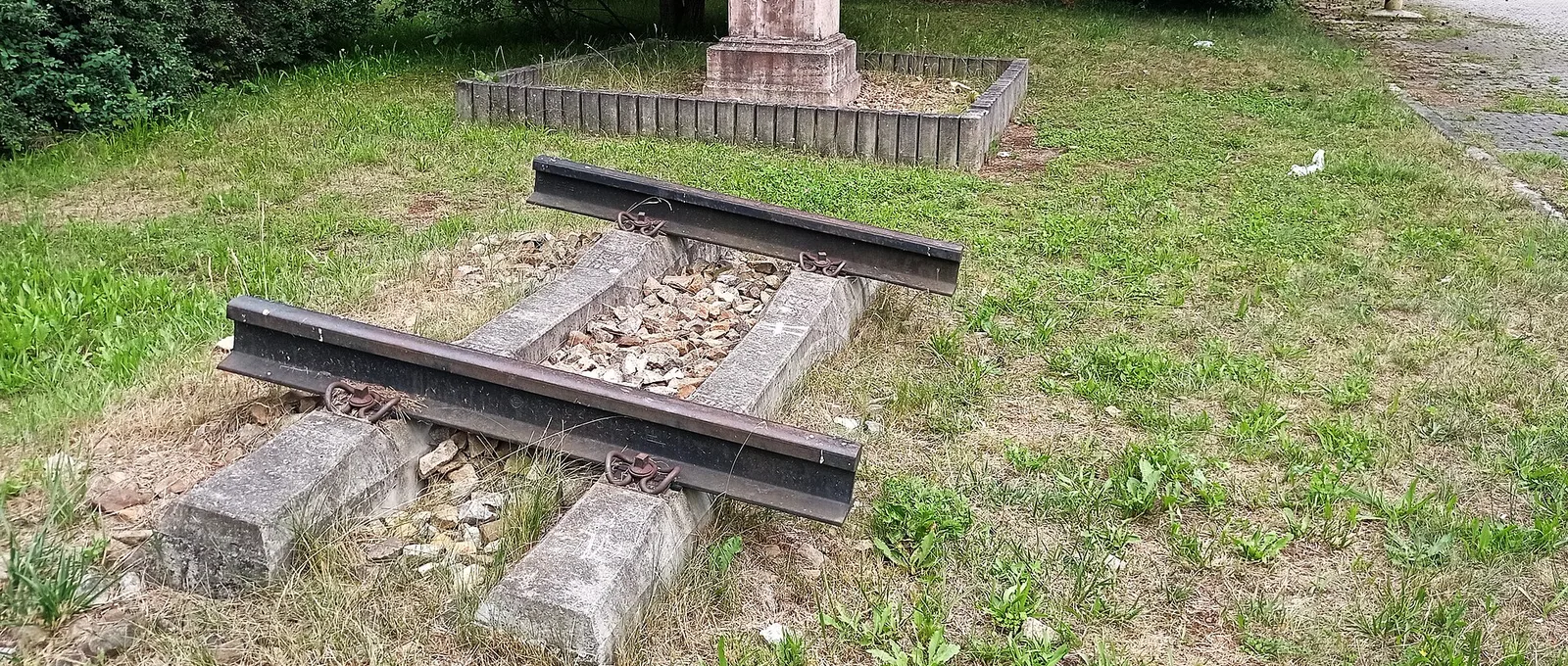
The granite is four feet of it, on the green, with forty-one names and the sentence ERECTED BY A GRATEFUL TOWN, 1923. I have been in the room where the subscription book for it is kept — a spiral-bound cash ledger, deposited with the historical society in 1978 by the granddaughter of the committee treasurer — and the book records one hundred and six contributions totalling $2,840, of which $1,900 came from nine people, of which $900 came from one.
The town's population in 1920 was a little over four thousand.
I do not think that makes the monument fraudulent, and I want to say that at the top, because the sentence I just wrote is the kind that gets excerpted. The men on it died. The town did put it up. Nothing in the ledger contradicts anything carved in the granite, and reading the ledger as an exposé is a category error that I have watched colleagues commit and have committed myself.
What the ledger does is change what the monument is evidence of, and that is the argument I want to make, because the substitution happens constantly and almost invisibly.
A monument is routinely read as a statement of what a community believed at the moment of its erection. It appears in that role in local histories, in dissertations, in exhibit labels, in the standard sentence that begins in 1923 the town expressed its. It is treated, in short, as an aggregate — an averaging of sentiment, rendered in stone. And it is nothing of the kind. It is the output of a fundraising process, and a fundraising process is a machine for converting a small number of committed people and a smaller number of large cheques into a permanent object.
The distinction has teeth because the historical record preserves the object and destroys the process. Granite lasts. Subscription books get thrown away when the last person who knew what they were dies, and the survival of ours is a piece of luck involving a granddaughter and a cleared attic. So the ratio of surviving monuments to surviving ledgers is enormous, and a discipline that reads what survives will systematically read fundraising outcomes as community consensus, across thousands of towns, forever.
Now the objection, and it is much better than the objection I usually get, which is that I am debunking. The good objection is this: it stood for a hundred years. Whatever nine men paid for it in 1923, four thousand people walked past it, and nobody in a century organised to remove it, alter it or add to it. Sustained absence of opposition over a century is a stronger indicator of assent than a subscription list is of anything, and my methodology, applied consistently, ought to weight the century more heavily than the ledger.
I think that objection is largely right, and answering it is the reason this essay exists rather than a footnote.
Here is what I would say. Absence in the record is precisely the thing I have argued elsewhere must be checked against an independent series before it can be read as evidence, and I am obliged to hold myself to it. So I went looking for the second series, which in a New England town is the town meeting warrant. If a monument were contested you would expect it to surface there — an article to appropriate funds, an article to reconsider, a motion from the floor recorded in the clerk's minutes.
What I found is that the monument never appears in the warrant at all, in any year. Not in 1922, not in 1923, not since. The committee was private, the money was private, the land was donated by one of the nine, and the town as a corporate body never voted on it once. The century of silence I was invited to read as assent is a century in which there was no mechanism through which dissent would have been recorded, because the matter never entered the one forum that keeps minutes.
That does not prove the town objected. Almost certainly it did not; I have no evidence of objection and I am not going to invent some. It proves that the century of silence is uninformative in the specific way the objection needed it to be informative, and the difference between those two positions is the whole of what a historian is for.
And then there is the second case, which is the one that made me confident rather than merely careful.
Eighteen miles away, a neighbouring town's committee tried the same thing in 1921 and failed. That committee's papers survive, in a different collection, because its secretary was a schoolteacher who kept everything. The papers include a subscription list that got to $410 and stopped, two letters declining to contribute — one polite, one not — and a final memorandum proposing that the money be returned. It was returned. There is no monument on that green. There is nothing on that green.
Now: if you read only monuments, that town has no opinion in 1921. It is absent from the record of commemoration entirely, and the standard sentence — in 1923 the town expressed — cannot be written about it, so it is not written, so the town does not appear in the survey, so the survey is composed exclusively of the places where the fundraising worked.
Two towns, eighteen miles apart, comparable size, comparable losses. In one the money came together and there is four feet of granite that a hundred years of historians have read as sentiment. In the other it did not and there is a memorandum in a box. I have no idea whether the two populations felt differently about anything. What I know is that one of them left a monument and the other left an absence, and that our methods are built to read the first and blind to the second.
The tidy lesson available here is that monuments lie, and I want to refuse it, because it is not what any of this shows. The granite is accurate. Forty-one men from that town died and a grateful town did erect it, if a town can be said to act through nine of its residents and a committee, which is how towns have always acted about most things.
What the ledger shows is narrower and, I think, more useful: that the object records a capacity, not a consensus. It tells you that in 1923 this place contained nine people with money and the will to spend it on this, and a committee competent enough to see it through, and no one sufficiently opposed to stop it. That is a real historical fact about a town and it is worth having. It is simply not the fact the standard sentence claims.
The treasurer's ledger has a second column I have not mentioned. Beside forty of the one hundred and six entries there is a tick in pencil, and beside eleven there is a small letter r. Nobody at the historical society knows what either mark means, the treasurer died in 1949, and I have spent four years failing to find a key. I would very much like to know whether the r means refused, because if it does, that column is the only surviving record of dissent in this entire matter, and it is eleven pencil marks, and it will stay unreadable.