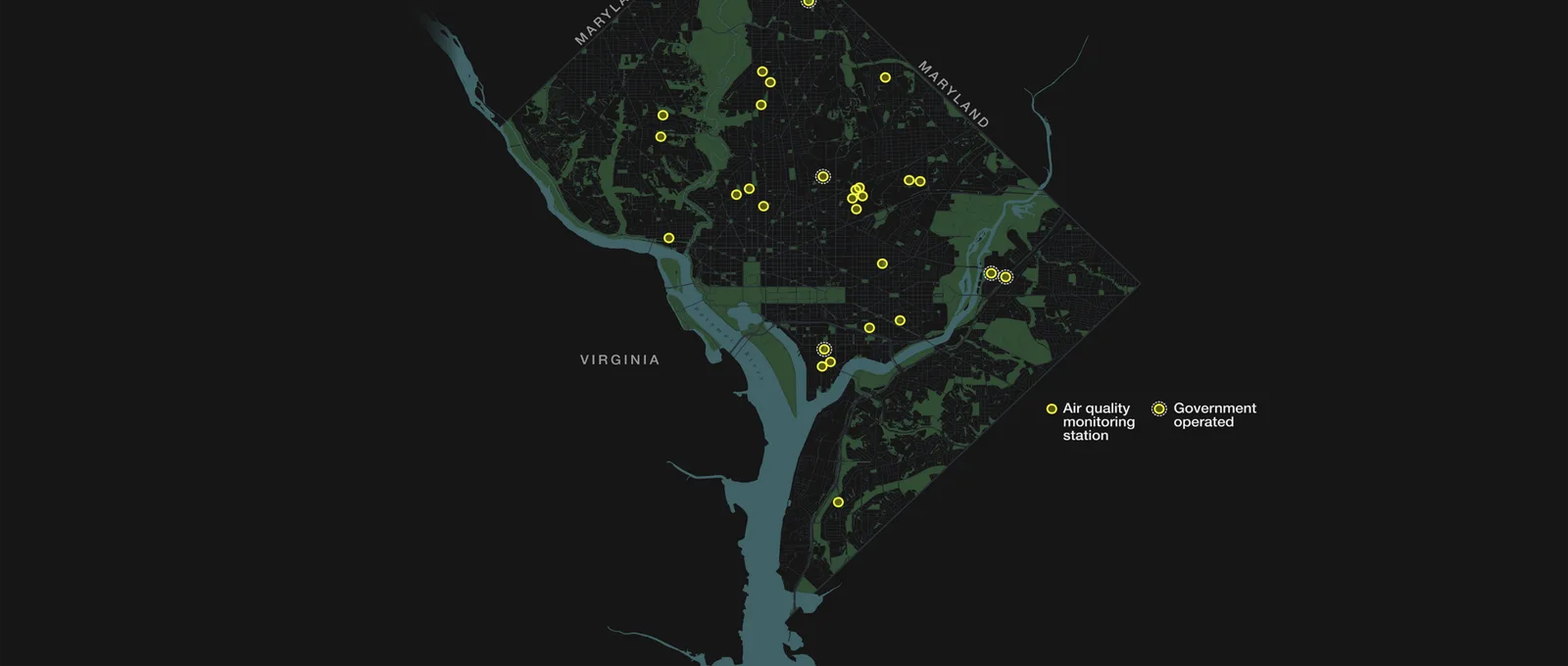
The continuous ambient monitoring station nearest to the block I was working in that year was one hundred and ten kilometres away, in a city, in a compound with a gate. The block has about two hundred thousand people in it. On the dashboard everybody looks at, it is not a low reading. It is not a reading at all.
That is a mundane fact about network design and it becomes a serious one the moment somebody says a national average out loud.
India's ambient monitoring network has grown enormously and I want that on the record before anything else, because the version of this argument that treats the expansion as cosmetic is not honest. The number of continuous stations has multiplied several times over in a decade. The data is published. The methods are documented. Compared to what existed when I started, it is a different country.
What has not changed is the shape of the network, and the shape is the argument. Monitors are sited where the regulation requires them, and the regulation is written around non-attainment cities, and cities are where the population density, the political attention and the mains power supply are. Every one of those is a good reason. Together they produce a network whose spatial distribution is very close to the spatial distribution of urban India, and a national statistic computed from it is a statement about urban India wearing the word national.
I have watched that statistic used in three ways it cannot support. As a trend for the country, when the network's composition changed underneath the trend. As a comparison between states, when the states have different monitor densities and the sparse ones are represented by their capitals. And as a denominator in burden estimates, which is the one that propagates furthest, because a burden estimate multiplies a concentration by a population and the population it multiplies by is everybody.
Now, the strongest thing said against this, and it is said by people whose work I rely on.
Satellite-derived estimates fill exactly this gap. Aerosol optical depth from orbit, calibrated against the ground network and combined with chemical transport models, produces gridded surface concentrations at a resolution that covers rural blocks with no station in them. This is real, it is validated, it is the basis of most global burden work, and it is why anybody can say anything about the block I was working in. Demanding a monitor in every block before acting on Delhi would be a counsel of paralysis, and the people who make that demand rarely mean it kindly.
I accept all of it, and it moves my claim rather than defeating it, because of what the calibration is anchored to. A satellite product is tuned against ground stations. The ground stations are urban. So the relationship between what the satellite sees and what a person breathes is estimated best where the stations are, and extrapolated where they are not — and the places where it is extrapolated are precisely the places whose emission sources are least like the calibration set. A rural block's particulate load is substantially household combustion, seasonal, at low altitude, and near the ground in the evening. A satellite column integrates upward through the whole atmosphere. The correction from one to the other is a modelled quantity, and it is modelled from urban data.
None of that makes the estimates useless. It means the uncertainty in the rural grid cells is materially larger than in the urban ones, and it is reported that way in the papers, and it is not reported that way anywhere else.
There is a second thing, and it is the one that made me stop treating this as a technical footnote.
The exposure that matters most for a very large number of people in this country is not ambient at all. It is indoor, from cooking, and it is measured by a completely different instrument in a completely different literature with a completely different community around it. A woman cooking on biomass in an unventilated room experiences concentrations that no outdoor monitor in any configuration would record, and she may live in a block whose ambient reading is unremarkable.
So the person with the highest exposure in a district can be invisible to the system built to find high exposure, and the programme that would help her — the cooking fuel programme — is administered by a different ministry and evaluated on cylinders delivered rather than on anything measured in a room.
What I am asking for is small and I have asked for it in two forums. Publish, next to any aggregate figure, two numbers the agency already holds: how many stations contributed, and what share of the population lives in a district with at least one. Not a new instrument. Not a new network. Two integers, which would make the difference between a state represented by eleven stations and a state represented by one visible to anyone who looked, and would make the sentence about the national average harder to say without qualification.
The station one hundred and ten kilometres away is well run. I have been inside the compound. The technician showed me the calibration log and it was current, and he had been doing it correctly for six years, and he was quite proud of it and had every right to be. He asked me what I was doing out here, and when I told him, he said there had been talk of a station in that block once, and then said the thing that has stayed with me, which is that they had not been able to find a site with an assured power supply and a wall.

Calibrated against the urban stations, so the uncertainty is largest exactly where the extrapolation is. That is the same structure as a species model trained on records from places with funded offices.