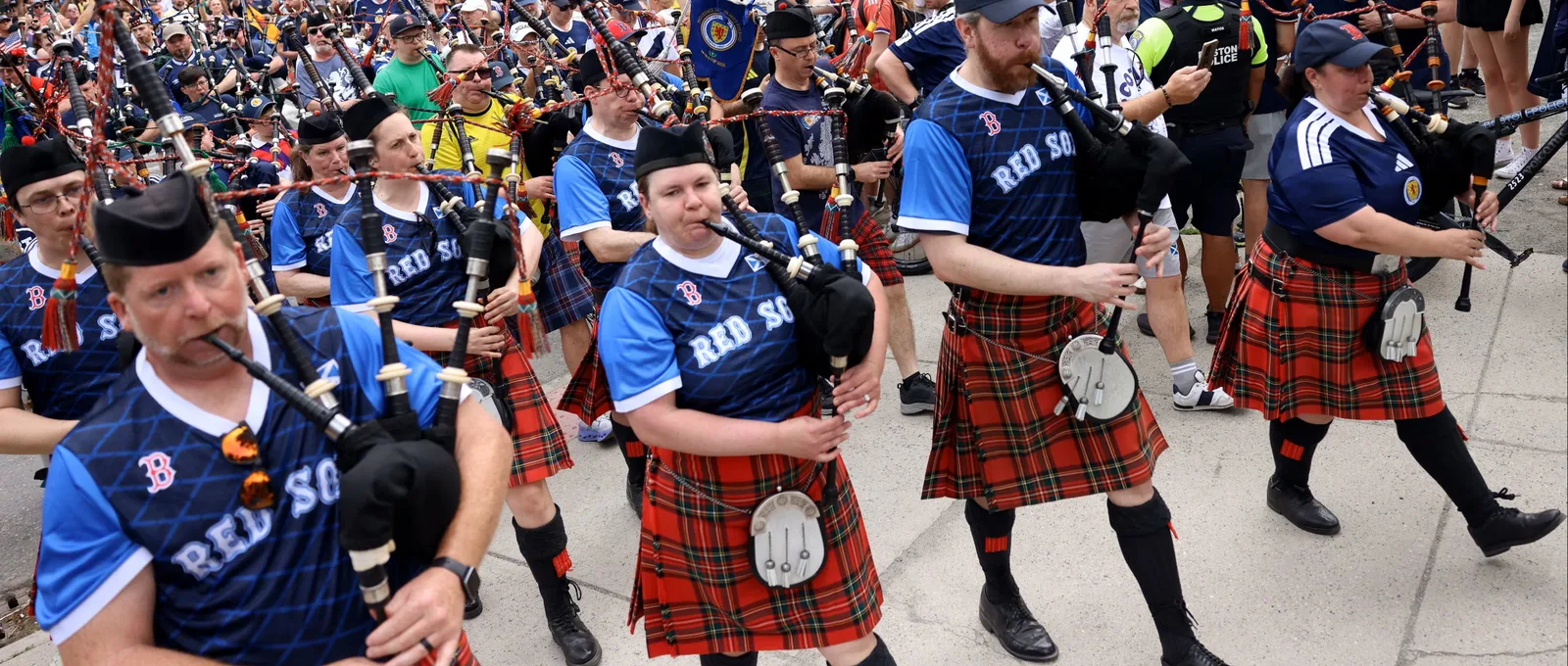

Twenty-eight years. That's how long Scotland had been away from a World Cup, which means that when we finally qualified — Hampden in November, Kenny McLean chipping the Danish goalkeeper from the halfway line while my father made a sound I had previously only heard from kettles — I did not so much book a trip to America as have an out-of-body experience that ended with flight confirmations. By morning I owned tickets to Boston and Miami, a hotel I could not afford, and a new kilt, because if you are going to represent your country abroad you do it with your knees out.
The kilt caused my first international incident, at the airport, where a security officer the size of a fridge looked at it on the scanner belt, looked at me, and said, "Sir, is this a skirt?" I said it was a kilt. He considered this for a long moment, the way a man considers a chess move, and then said, "Cool. Welcome to America," and that, more or less, set the tone for the entire month: total confusion, followed immediately by total warmth.
Boston did not just tolerate the Tartan Army; Boston adopted us like a stray dog it had always secretly wanted. Within an hour of landing I had been bought a drink by a plumber named Sal, taught the word "wicked," and asked, very kindly, whether Scotland was "the one with the leprechauns," at which point Sal's mate corrected him — "that's Iceland" — and I decided some battles are not worth fighting when the beer is free. The Irish pubs took one look at several thousand sunburnt men in kilts singing about being on the march with Ally's Army and declared us family. A barman in Southie learned the words to "No Scotland, No Party" in a single evening. A police officer on a horse let a man from Falkirk wear his hat. I paid nineteen dollars for a pint of Guinness and tipped on top of it, because the lassie called me "my love" and I am weak.
There was, however, the small matter of the ticket, which said "Boston Stadium" in the same way a tin of dog food might say "beef." Boston Stadium is not in Boston. It is in Foxborough, a forty-minute train ride away, a gleaming spaceship parked in a field beside a shopping outlet, and on match day the whole of Scotland squeezed onto a special event train alongside Haitian fans in brilliant blue, everybody sharing crisps and phone chargers and the particular nervousness of small footballing nations. Our first World Cup match in twenty-eight years, and it kicked off next to a discount Timberland store. I found this strangely comforting. Scotland has never once been glamorous, and it would have been unsettling to start now.
The Haiti match itself took roughly four years off my life. We scored early in the piece, and then the remaining time had to be survived, because a 1-0 lead in a World Cup, with your nation's entire self-esteem riding on it, is not a football experience so much as a cardiac event with catering. Every Haitian attack, the whole tartan end inhaled at once; you could hear ten thousand men whispering "no, no, no, NO" in perfect unison like a nervous choir. And then the whistle went, and it was 1-0, and it stayed 1-0 forever, and grown men who fix boilers for a living stood greetin' into each other's shoulders in the Massachusetts sunshine. Our first World Cup win since 1990. I phoned my da from the concourse and told him, and he said nothing for a long time, and then he said, "Aye," and hung up, which for a Scottish father is the emotional equivalent of an opera.
Five days later Morocco beat us 1-0 in the same ground, and I want to be bitter about it, but their fans were so magnificent — the drums, the joy, the noise like weather — that losing to them felt almost like being included in something. Afterwards you could find Scots all over Boston in bucket hats doing group-stage arithmetic on their phones like NASA engineers: right, so if the best third-placed teams... if we get something against Brazil... We were, at this point, sincerely planning to get something against Brazil. Hope is a national illness and there is no vaccine.
Miami was a different country wearing the same flag. Boston had adopted us; Miami charged us for the privilege, then charged us a resort fee on top. The heat is not weather down there, it is an event that happens to your body — I stepped out of the airport and my kilt wilted like lettuce — and everything glittered and everything cost forty dollars and a man at a rooftop bar asked if our outfits were "a festival thing." But the kindness found us there too, just in different clothes: an old fella in Little Havana who fed us thimbles of Cuban coffee strong enough to reanimate the dead and refused payment because we'd "come so far for futbol," and an Uber driver who, upon learning we were Scottish, respectfully switched off his reggaeton and put on bagpipe music from YouTube, which was somehow worse than anything Brazil would do to us.
And Brazil did what Brazil does to Scotland, which is everything, beautifully. Three-nil at the Hard Rock, each goal more casual than the last, eleven men in yellow playing a sport that only occasionally resembled ours. The walk back across that scorching car park felt like a pilgrimage across a griddle. And here is the thing I keep turning over: in 1998, my father watched Scotland go out of a World Cup at the hands of Brazil and Morocco. In 2026, I watched Scotland go out of a World Cup at the hands of Morocco and Brazil. Twenty-eight years of waiting, and our great national achievement was learning to lose to the same two teams in a different order. And yet nobody left. The Tartan Army stayed and sang long after full time, the Brazilians drummed along, the stewards filmed it on their phones, and before flying out the fans did what they always do and handed over a pile of money to a local children's charity, because if you cannot win a World Cup you can at least behave like champions of something.
I had booked my flights home for the twentieth of July, out of pure hope, which is the most Scottish injury there is, so I stayed on as a neutral — and that is how I ended up at the third-place match in Miami, where tickets were the only thing in America getting cheaper, watching England beat France 6-4 with a Bukayo Saka hat-trick while forty thousand England fans sang about football coming home at a bronze final. I sat very still throughout, like a man at the wrong wedding, and I will not be describing my feelings further because children may one day read this. The next morning I flew back to Boston, walked into the same Southie pub, and watched Spain beat Argentina 1-0 in extra time on the big screen — Ferran Torres, Messi face-down on the turf, and at half time, I swear to you, Shakira and BTS and Madonna performed a full concert in the middle of the World Cup final, and every American in the bar found this completely normal while I quietly aged a decade into my pint. The barman saw my face and kept my glass full. "On the house," he said, "for the boys in the skirts."
At Edinburgh airport the customs man asked if I had anything to declare, and I nearly told him the truth: one sunburnt neck, one broken heart, one nineteen-dollar pint still under review, and the knowledge that a whole continent of strangers had treated a nation of gallant losers like returning kings. The next World Cup is in Spain, Portugal and Morocco. Morocco. Again. I've already opened the savings account.